Introduction
Career-switch log: the destination is penetration testing, and I have been circling the runway for a while. Security Engineer and DevSecOps on TryHackMe are done, the Kali VM is warm, and the logical next step is a first certification that proves I can attack a machine instead of hardening one.
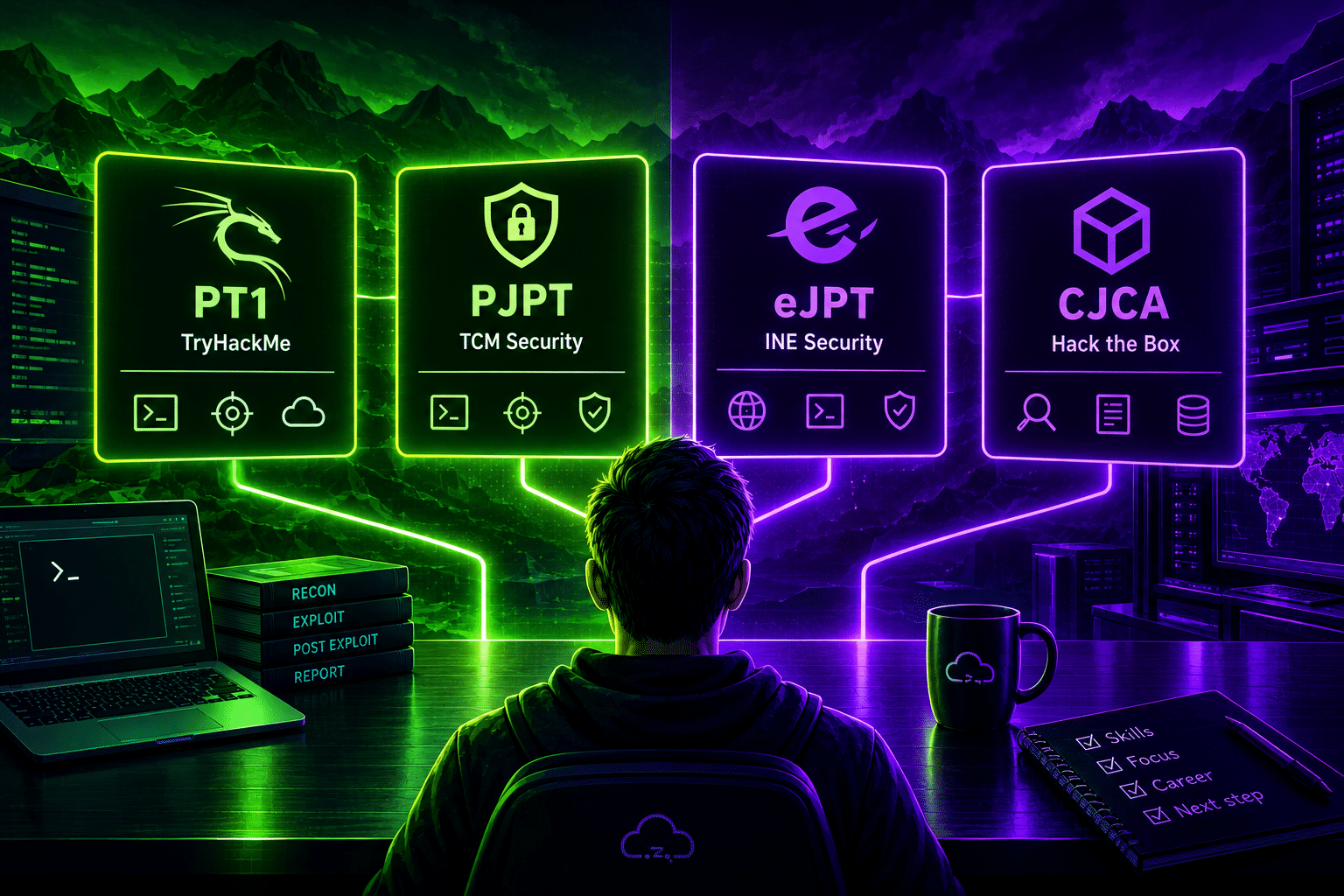
Choosing one turned into a research hole. Forum threads recommend something different each time, usually whichever cert the poster finished last. So I read the official pages, a pile of pass reports, and enough grumpy Reddit threads to qualify for moderator status. Four candidates survived: TryHackMe’s PT1, TCM Security’s PJPT, INE’s eJPT, and Hack The Box’s CJCA.
My filter is simple: quality of the material, how much I learn, and how hands-on it is. HR recognition is somebody else’s problem for now; price matters, but as a tiebreaker.
Four certs
The four certs side by side, with some quick numbers.
| Cert | Exam | Prep material | Price |
|---|---|---|---|
| THM PT1 | 48 hours: web + AD + network + report | ~95 hours, 18 modules | $349 |
| TCM PJPT | 48 hours AD compromise + 2 days report | ~20 hour course | $249 |
| INE eJPT | 48 hours black box, ~35 questions from findings | ~150 hour path | $249 |
| HTB CJCA | 5 days: attack + SIEM triage + report | 20 modules, 100% required | $105 + sub |
TryHackMe PT1
PT1 is TryHackMe’s first offensive certification (May 2025) and the closest to home, since I already pay them rent. The prep path spans 18 modules and roughly 95 hours, and it is current: the 2025 OWASP Top 10, CVE rooms from last/this year, privilege escalation on both operating systems, Active Directory basics, and a report-writing room I would later regret skimming.
The exam gives you 48 hours across three scoped engagements: a web application, a small Active Directory domain, and a couple of network hosts; about ten flags in total, randomized per candidate, so write-ups are useless. You hand in a client-style report with CVSS scoring, and an LLM with human spot-checks grades it. One free retake, $349 including three months of premium.
Reviewers with far more alphabet soup on the shelf than I have call it the most realistic junior exam of the four; the dragkob review (OSCP, eJPT, eCPPT) scores it above the eJPT, and sth.sh agrees on the exam design. The complaints from a candid r/tryhackme review: it is web-heavy enough to deserve a “web specialist” subtitle, the AD section is gentle, support runs office hours while your exam clock runs weekends, and the AI grader occasionally produces scores that need a support ticket to explain. Failure stories mention candidates capturing nine of ten flags and still failing on report quality.
TCM PJPT
The PJPT bundle is one course plus an exam: Practical Ethical Hacking, about 20 hours from Heath Adams, who by community consensus teaches beginner hacking better than anyone else with a microphone. Active Directory takes the lion’s share, and the exam mirrors it: 48 hours to take an internal network from a foothold to Domain Admin, then two extra days to write it up as a professional report. Unproctored, AI tools allowed if you disclose them, one free retake, $249.
Two things to know. The exam environment mirrors the PEH lab, so think supervised dress rehearsal rather than improvisation theatre. And the report is the gatekeeper here too; r/pjpt is full of people who owned the domain in three hours and then wrote themselves a fail over the following two days. TCM itself was acquired in late 2025, course access moved from lifetime to 12 months, and the community watches that transition with mild suspicion.
INE eJPT
The oldest name here and, for my money, the weakest link. The eJPT exam itself is respectable: 48 hours against a simulated corporate network, roughly 35 multiple-choice questions you can only answer by actually compromising machines, 70% to pass, no Active Directory, no report, one free retake. It checks what you can do at a keyboard, which already beats most entry exams.
The training is the problem. The Penetration Testing Student path runs 150-plus hours, much of it slides narrated as video, with a Metasploit dependency and the occasional deprecated tool; the Red Team Guide review calls it dry, and 2026 reviews still describe the same material. Most 2025 and 2026 threads agree: a fine first cert if you have never touched a lab, skippable if you already live on TryHackMe or HTB, and head-to-head comparisons favor the PJPT for realism. I already live on TryHackMe. I skipped it.
HTB CJCA
HTB’s entry cert launched in July 2025 and it is the odd one out: red and blue at once, by design. Five days, three phases: flags on a simulated enterprise network, alert triage in an Elastic SIEM where every true/false-positive call needs a KQL query to justify it, and a report. The voucher lists at $105 (at the time of writing), but you must complete 100% of the 20-module path first, grading takes up to 20 business days, and pass reports describe a cert that sits above the eJPT and nowhere near the CPTS. The SIEM phase reportedly out-punches a typical SOC level one job, which is impressive and also a detour if your destination is red.
The timing note that changed my spreadsheet: HTB restructured its subscriptions in October 2026, moving to tier-based access and new rates. The numbers that matter now: Silver Annual at $550 unlocks all Tier 0-II content and bundles two exam vouchers per year, one CJCA plus one specialist of your choice: CPTS, CWES, COAE, or CDSA. Vouchers last 365 days and include two exam attempts each.
Enter CPTS
One more cert kept showing up in my research: HTB’s CPTS, which reviewers keep calling “the one that teaches you the most”. Ten days, an enterprise network of around eight machines, the full Active Directory attack chain with pivoting, twelve of fourteen flags, and a commercial-grade report. The deephacking review names that report as the biggest failure point, even for people who root every box. Reviewers rank the cert above the OSCP on realism per dollar.
CPTS assumes the fundamentals are already in place; even CJCA passers describe their cert as about five percent of it. So I put it at the end of my 2027 timeline, after a junior cert. The math helps: one $550 Silver Annual covers the CJCA path, the CPTS path, and a voucher for each. The alternative climax is TCM’s PNPT at $499: five days, a live debrief with examiners, and zero flags anywhere.
My verdict, for now
My working plan, subject to change without notice: PT1 as the first cert. I am already in TryHackMe, the path is half done, and the exam format is the most realistic of the junior bunch. Alongside it, the free PortSwigger Web Security Academy, because the PT1 exam leans on web skills more than anything else.
The alternative I keep re-checking: switch ecosystems, buy the Silver Annual, and collect CJCA and CPTS on the way past. Two things tip me either way: whether I want a blue-team detour this early (CJCA’s SIEM phase), and whether one randomized PT1 exam is worth $349 against a bundle that ends with a stronger cert. I am not sure yet.
One lesson from all four exams: the report is key. The fail stories I read shared this: someone who could pop machines and could not document them. I write reports for my lab machines now. It is as fun as it sounds.
Next
I’ve been working quite a while on a iOS and Android app accompanying my self hosted cybersecurity dashboard. Next two weeks I’ll do a write-up on them.